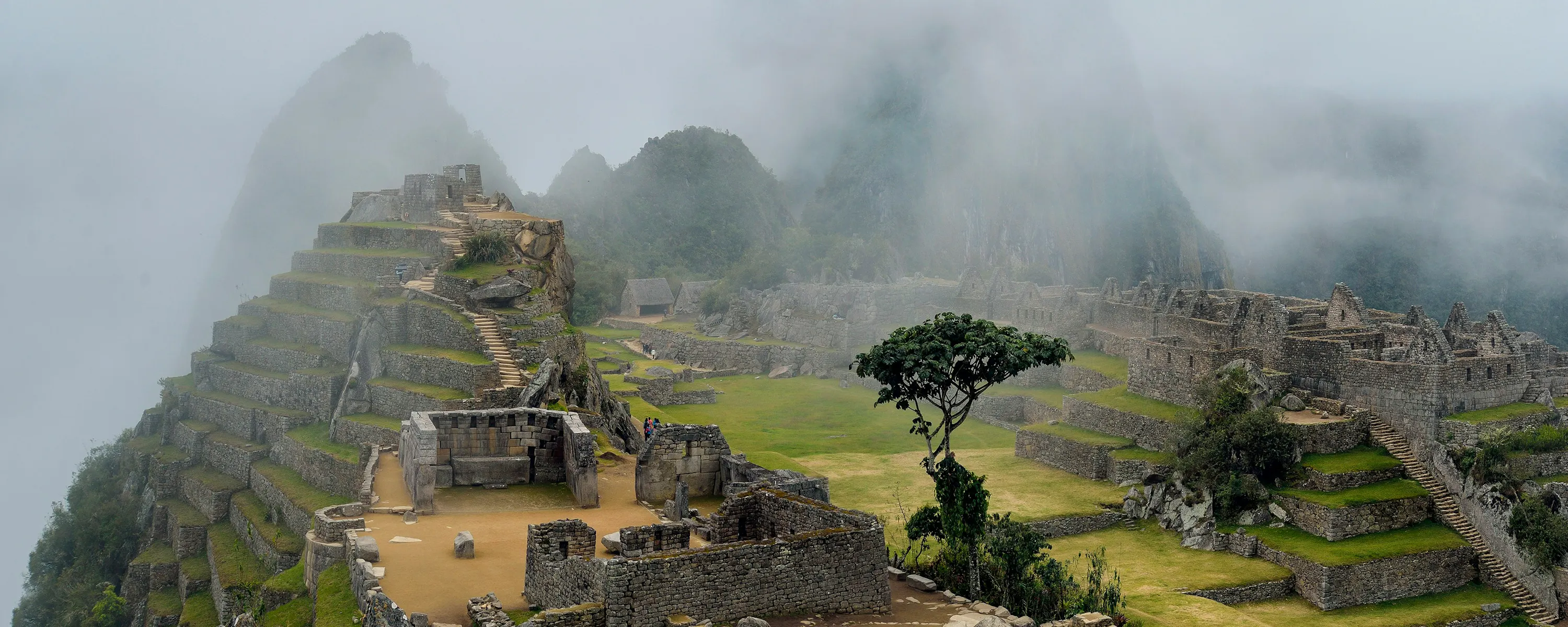
Machu Picchu Circuits explained: what to know & how to choose the right route
Three circuits, ten routes, one unforgettable icon. Our specialists break down the viewpoints, inclusions, and seasonality to guide your choice.

September 4, 2026
For centuries, jungle and mist draped the Incan citadel of Machu Picchu, hidden among peaks in the Peruvian Andes until its rediscovery in 1911. More than a hundred years later, it remains just as alluring.
For a long time, visitors wandered the ruins at their own pace, following their tour groups or guides wherever their curiosity led them. That changed in summer 2024, when the Peruvian Ministry of Culture introduced designated circuits to control crowding at the UNESCO site. Now, when booking entry tickets, you'll choose your circuit in advance and remain on that route for the full visit. That means no backtracking, no switching, and no re-entry without a separate ticket.
This guide covers what you need to know about the new circuits so that your first conversation with a Peru specialist starts from a place of understanding, not guesswork. Our experts know the site circuit by circuit and once they get to know you — your interests, preferred pacing, and how much hiking you're willing to do to earn your views — they'll match you to the right route. From there, they knit your private Machu Picchu tour into a seamlessly woven Peru itinerary. With tickets secured and reservations confirmed, you're free to simply feel what pulled the Incas to these sacred mountains in the first place.
Understanding the Machu Picchu Circuit system
Three main circuits cover the citadel, each tracing a different section of the site. Within them, 10 total routes branch off to include side hikes to nearby landmarks such as the Sun Gate and Huayna Picchu. Some circuits remain on the upper agricultural terraces above the city; others cut through the urban core. A handful run only in certain seasons, while most operate year-round.
Here's how the three main circuits at Machu Picchu break down:
- Circuit 1 (Panorámico): This route holds to the upper terraces, with views over the city from a series of panoramic lookouts. It does not enter the ruins themselves.
- Circuit 2 (Clásico): The most popular of the three, this circuit combines the panoramic viewpoints with a full walk through the citadel's interior.
- Circuit 3 (Realeza): This route skips the famous overlooks and heads straight into the urban core and lower-level areas. It's the only path to the Huayna Picchu climb.
Circuit 1: panoramic views from above
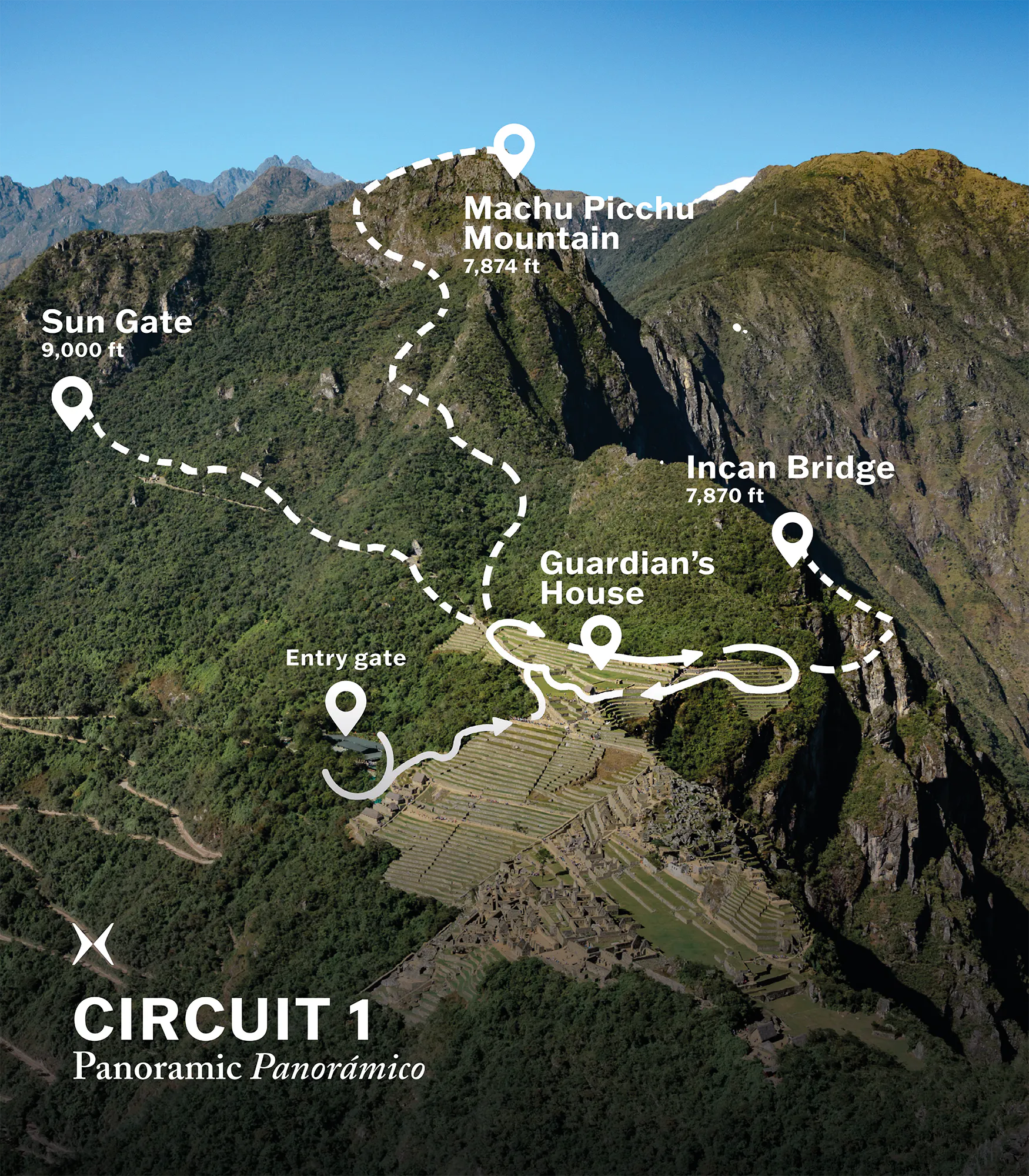
Circuit 1 comprises four routes, all built around the same core path. From the entry gate, the trail climbs through cloud forest to the upper agricultural terraces, arriving at the Guardian's House for the classic Machu Picchu panorama: the ruins arrayed below, Huayna Picchu rising regally above.
What distinguishes the four routes is the side hike attached to each:
- Route 1-B — Upper Terrace: This is the shortest option, a roughly mile-long loop around the upper terraces to the Guardian’s House viewpoint before exiting. Depending on your pace, it can take around 90 minutes. This easy route is open year-round, is suitable for all ages, and requires a low level of fitness. All of the following routes include this one.
- Route 1-A — Machu Picchu Mountain: This route includes access to Circuit 1, as well as a side hike up Machu Picchu Mountain for higher-up views. Open year-round, the total route takes around 4.5 hours and is best for ages 12 and older. Due to the ascent up Machu Picchu Mountain, those without a fair level of fitness or who experience vertigo may want to skip it.
- Route 1-C — Sun Gate (Inti Punku): This three-hour option includes a side hike up to the famous Sun Gate, the traditional entryway to the citadel via the Inca Trail. The path here is gradual and wide, making it an easier, more family-friendly Machu Picchu hike than 1-A. However, this route is only open from June 1 to October 15.
- Route 1-D — Inca Bridge: This two-hour, adults-only route follows a narrow cliffside trail to a suspended log bridge. The path is mostly flat, so it’s a nice way to reach an alternative vista without the uphill walking, but the exposure and drop-offs mean no children are allowed. This is another seasonal route, operating between June 1 and October 15.
Circuit 2: the classic, complete experience
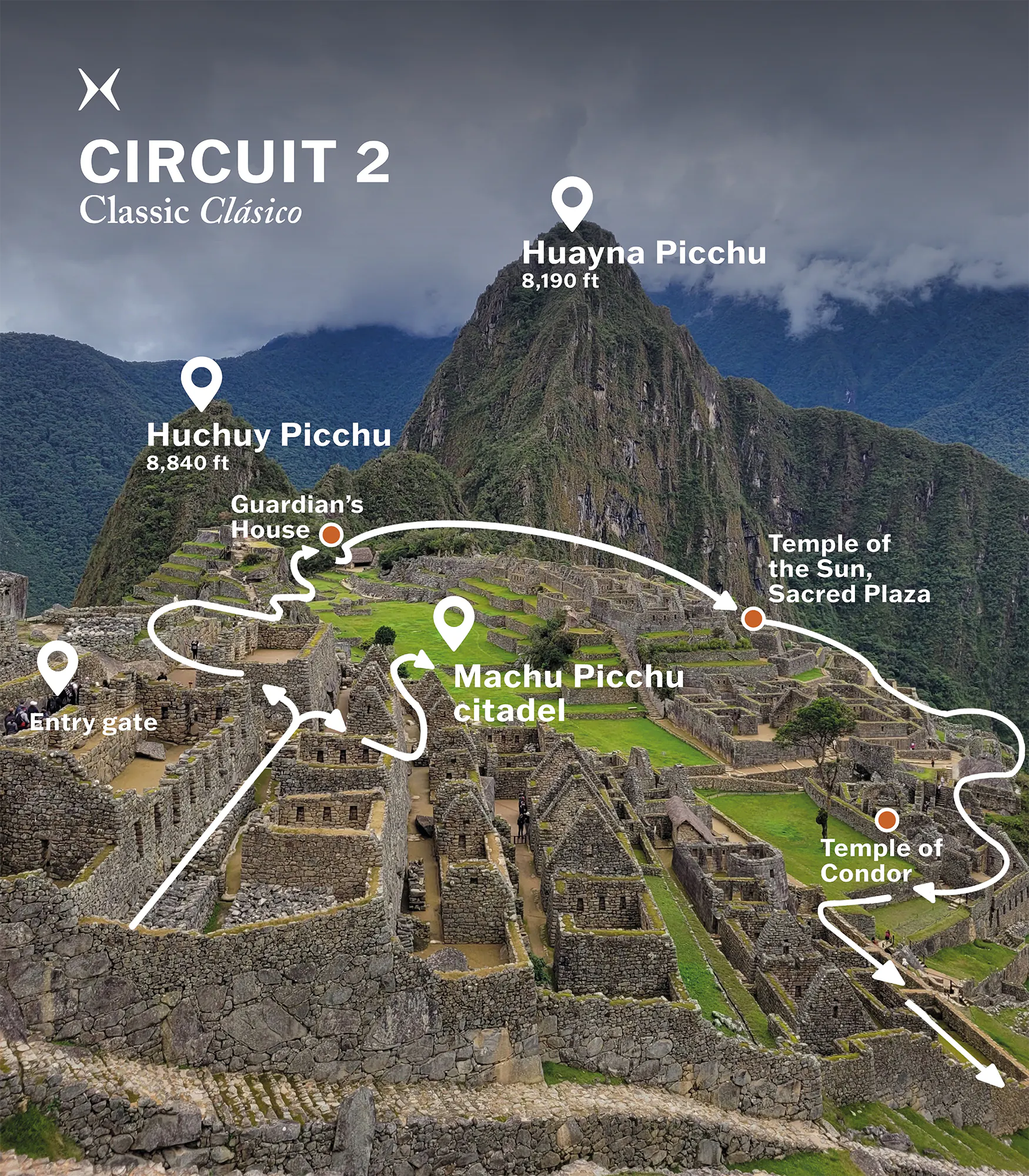
Circuit 2 combines panoramic views with a walk through the ruins themselves, hitting essential Machu Picchu highlights on a single route. That makes it the most popular circuit and, in peak season, the busiest. At a comfortable pace, Circuit 2 takes 2.5 to 3 hours, runs year-round, and suits all ages with a low-to-moderate level of fitness.
Like Circuit 1, it opens at the panoramic viewpoint near the Guardian's House before descending into the citadel. From there, it covers both the upper ceremonial zone and the lower residential and agricultural areas, taking in highlights such as the Temple of the Sun and the Sacred Rock. A few sub-routes offer slight variations from here:
- Route 2-A — Classic Route: After the panoramic viewpoint, you enter the citadel through its original gateway and move through the ruins, visiting popular sites including the Sacred Plaza.
- Route 2-B — Lower Terrace Route: This option is almost identical to 2-A, but the viewpoint is slightly wider and more panoramic, while 2-A offers the more classic, recognizable shot. In practice, both are excellent.
Circuit 3: the lower sector and mountain hikes
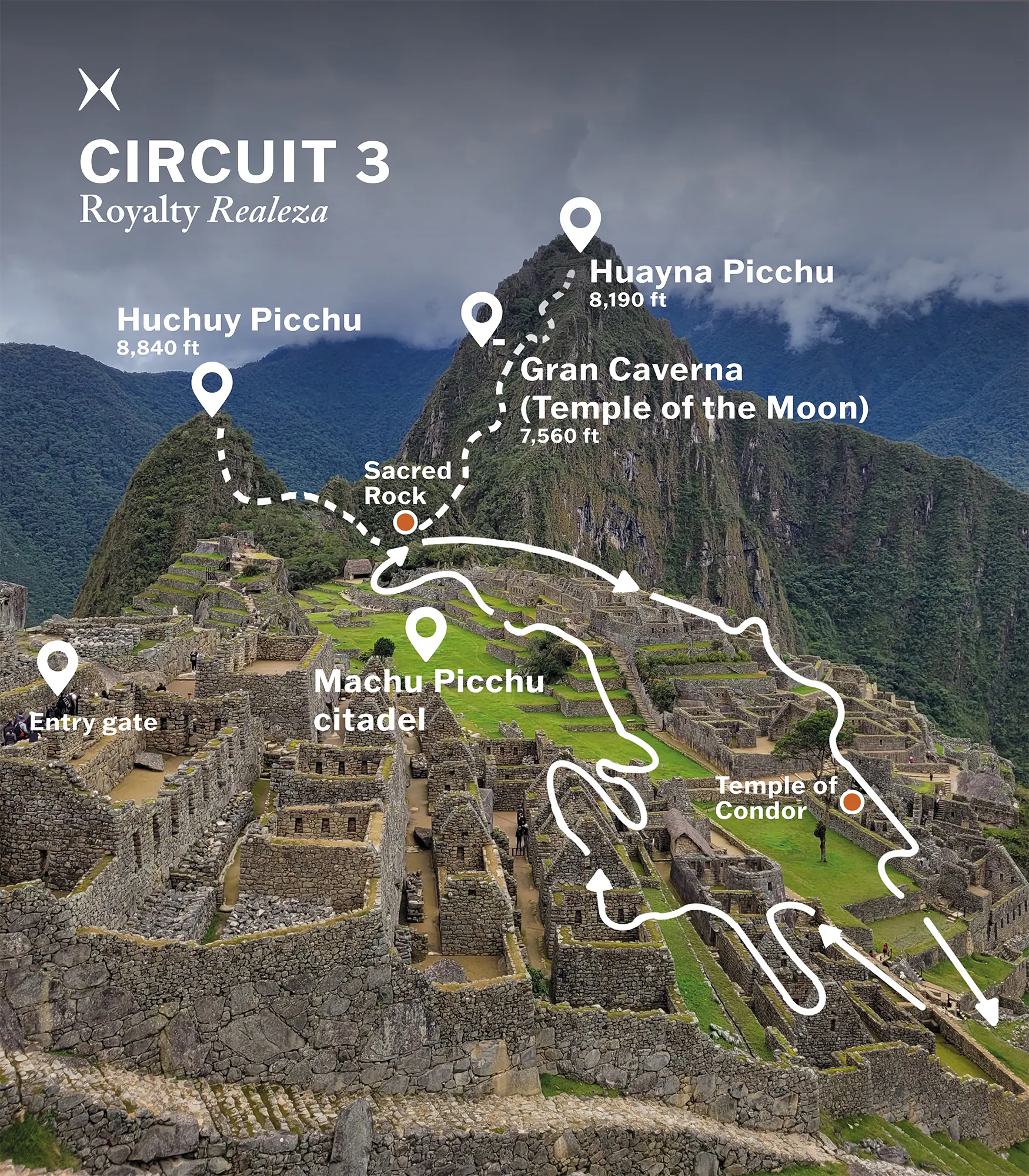
The most important thing to know about Circuit 3 is that it skips the panoramic viewpoints around the Guardian's House and the upper terraces, sticking to the lower half of the citadel instead. It still reaches plenty of highlights along the way, including the Sacred Rock and the Temple of the Condor, with a few side hike options depending on the route. All four sub-routes include the 3B loop:
- Route 3-B — Standard Route: This is the standard Circuit 3 path; a roughly 90-minute to two-hour loop through the lower section. It’s the least demanding, requiring a low level of fitness, and is accessible year-round.
- Route 3-A — Huayna Picchu Mountain: If climbing Huayna Picchu, the pointed peak in the background of all the classic Machu Picchu photography, this is the route to book. Open year-round, the total route takes around four hours, including the 90-minute climb up and down the peak. With steep paths and exposed sections, Huayna Picchu requires a high level of fitness, and involves uneven stairs and some scrambling. Daily access is very limited, so if this hike is a priority, raise it during your first conversation with our Peru specialist.
- Route 3-D — Huchuy Picchu: This 3.5-hour, moderate hike ascends a smaller, easier peak, offering comparable views to Huayna Picchu minus the exposure and intensity. This route is suitable for families, but has the downside of being seasonal, closing from October 16 through May 31.
- Route 3-C — Gran Caverna (Temple of the Moon): This route accesses one of the least-visited but most fascinating sites at Machu Picchu: a ceremonial cave carved into the rock face beneath Huayna Picchu. This is a longer option, requiring five to six hours to complete the full loop and side hike, but is worth it to see a different part of the citadel. This is also a seasonal route (June 1–October 15) and requires a high fitness level.
Which Machu Picchu Circuit to choose
With only one day, Circuit 2 is the strongest choice for a private Machu Picchu tour, especially if you are a first-time visitor. It covers both the panoramic viewpoints and the citadel’s interior in a single route.
With two days, we favor Circuit 1 on day one and Circuit 3 on the second. Together, they cover the same ground as Circuit 2, seen from two distinct vantage points, at a pace that allows real time in each area rather than a walk-through. If Circuit 2 isn't available, pairing Routes 1-B and 3-B is a practical substitute that covers much of the same terrain. And at three to four hours combined, both are short enough to complete in a single day.
Machu Picchu circuits at a glance
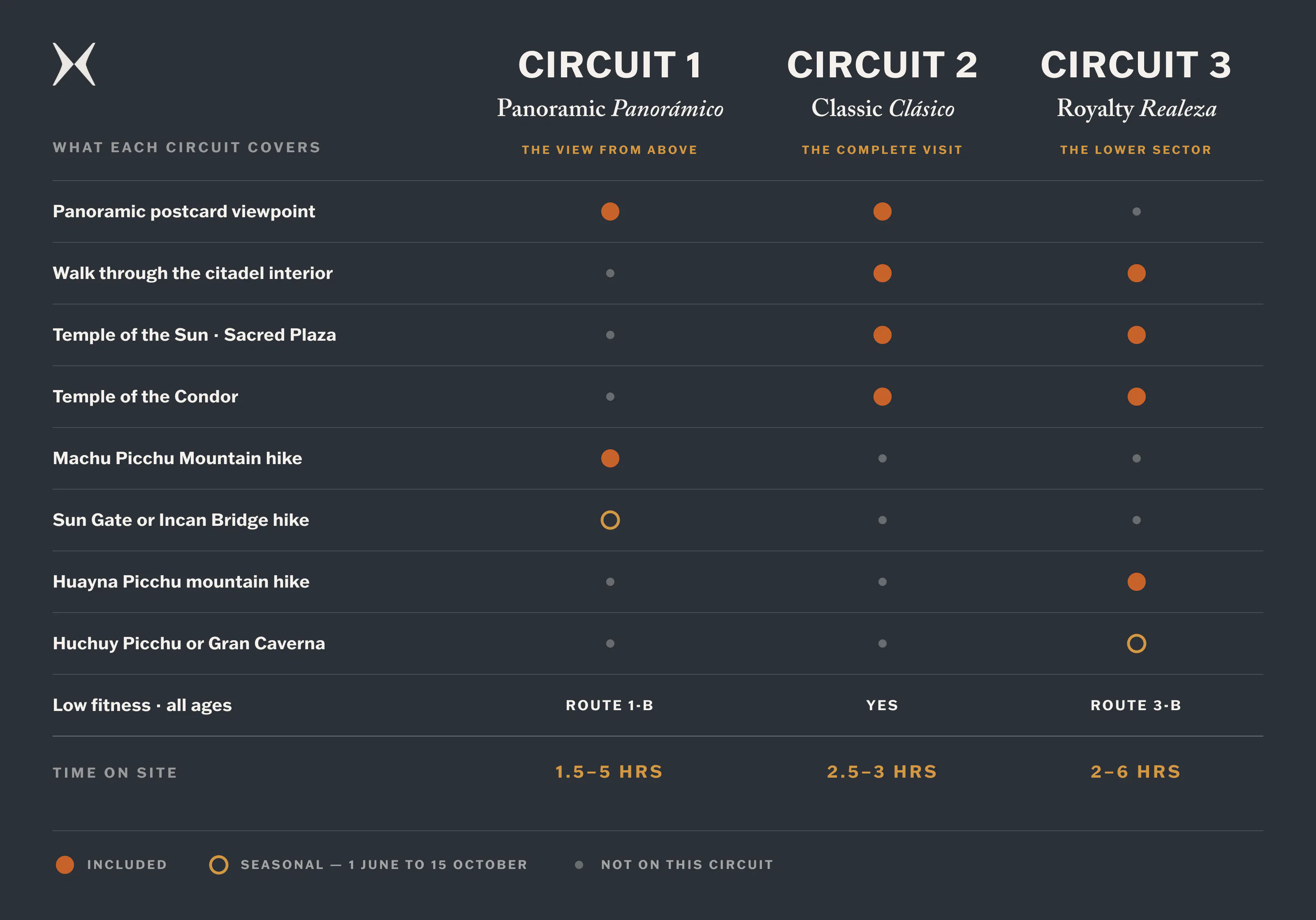
How to pick the right Machu Picchu circuit for you
There's no “right” or “wrong” circuit. Your choice depends on how you want to experience Machu Picchu and permit availability.
Some travelers want the classic postcard view and to walk through the ruins in a single visit; others prefer to slow down, split the experience across two days, and work in a climb up Huayna Picchu or the Sun Gate. Neither is a compromise, just different ways of meeting the same citadel.
A few factors shape the decision:
- How much time you have. A single day narrows things to Circuit 2; two days open up the full range of routes and side hikes.
- Fitness and comfort with heights. Routes like Machu Picchu Mountain and the Inca Bridge involve real elevation gain or exposure; the Upper Terrace loop does not.
- Whether you’re traveling with children. Some routes, such as the Inca Bridge, are adults-only; others are built for all ages.
- Time of year. The Sun Gate and Inca Bridge routes run only June through October, which can narrow the field depending on your travel dates.
- What you most want to see. The Guardian's House panorama, the Temple of the Sun, the Temple of the Condor, and a Huayna Picchu ascent each live on a different circuit.
Machu Picchu Circuits FAQs
Start planning your private Machu Picchu trip with Extraordinary Journeys
When you're ready, the best next step isn't more research. It's a conversation. Tell us what you're dreaming of. We'll take it from there.
September 4, 2026
Explore luxury Peru travel itineraries
Every trip with Extraordinary Journeys is tailor-made, crafted in collaboration with one of our destination specialists. Use these as a starting point, or as inspiration to create your own journey.